Detailed Property Inspection
We check pet resting areas, carpets, upholstery, floor edges, cracks and other hotspots where adult fleas or immature stages may be concentrated.
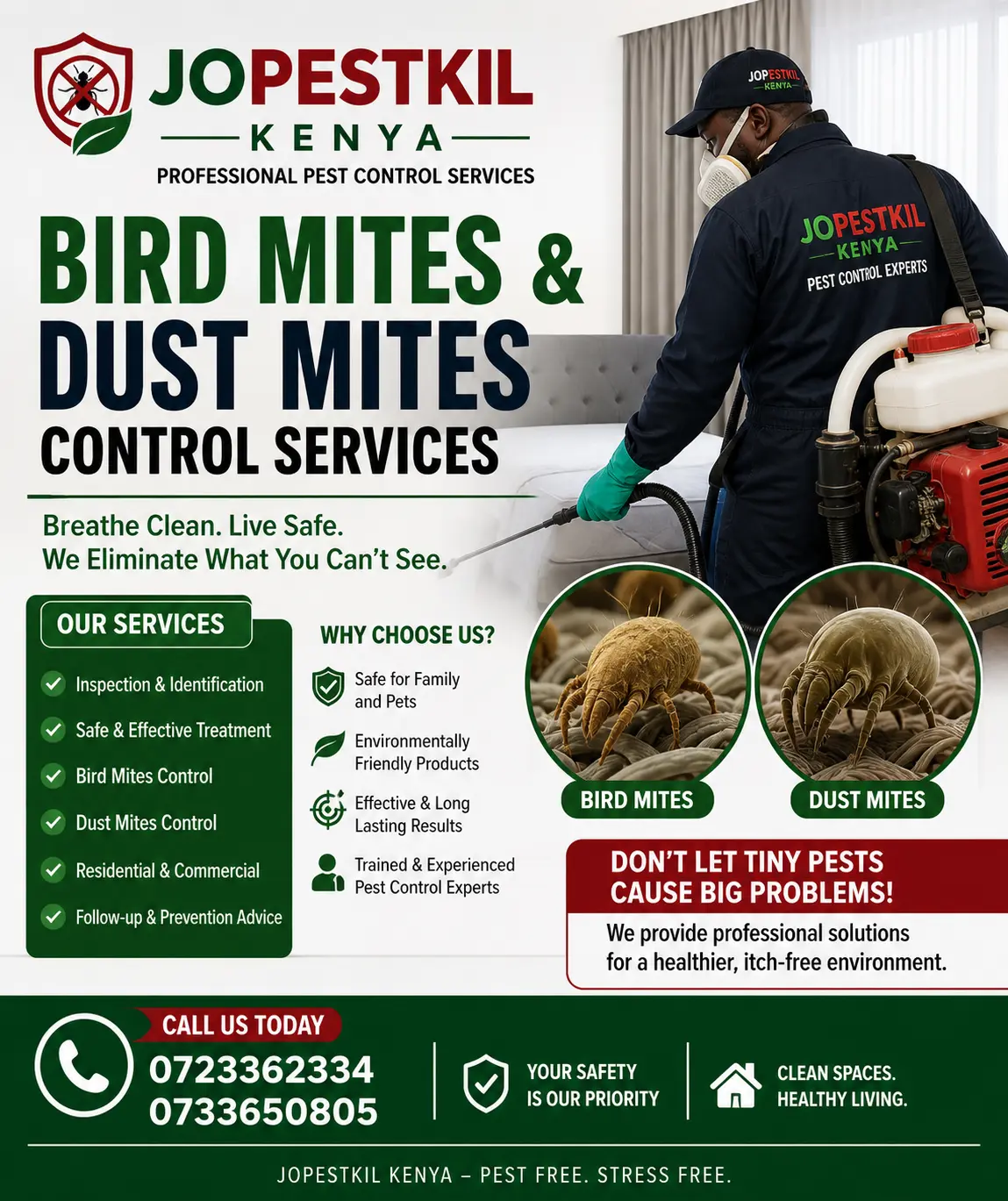
Professional Bird Mites & Dust Mites Control in Kenya
Mites are extremely small arthropods related to ticks and spiders. Mites either known as bird mites or dust mites commonly live in household dust, while others are associated with birds, poultry, animals, plants or damp environments. Because different mite species have different behaviours and habitats, effective mite control begins with identifying the type of mite and understanding where it is coming from.
Mites are tiny pests that are often invisible to the naked eye, yet they can cause serious discomfort, allergies, and damage to property. From dust mites that trigger asthma and skin irritation to bird and rodent mites that bite humans, these pests can quickly spread if not dealt with professionally. At Jopestkil Kenya, we provide effective and safe mites control services in Nairobi Kenya, ensuring your home, office, or business remains healthy and pest-free.
Jopestkil Kenya provides professional bird mite or dust mite infestation management and mite-control solutions for residential and commercial properties in Nairobi and across Kenya.
Our approach combines inspection, identification, environmental management, targeted mites fumigation treatment and prevention recommendations to help customers deal with persistent mite problems.
New and regular clients choose Jopestkil Kenya because of our professionalism, reasonably affordable pricing, fast response times, and commitment to customer satisfaction. We focus on complete flea elimination and long-term prevention, ensuring all our clients receive effective flea management solutions that they can trust year round. We start by understanding the infestation, then use a targeted plan designed around the property and the flea behaviour.
We check pet resting areas, carpets, upholstery, floor edges, cracks and other hotspots where adult fleas or immature stages may be concentrated.
Treatment is applied to suitable affected areas based on the inspection, with attention to places where fleas develop or repeatedly contact people and pets.
Where the problem extends outdoors, we assess shaded resting areas, kennels, verandas or other locations that may support continuing flea activity.
Because flea life stages can emerge over time, follow-up may be recommended together with cleaning, vacuuming and pet-care coordination.
Fleas can build up quickly when pets, resting areas and indoor furnishings provide the right conditions. Adult fleas may be the most visible stage, but eggs and developing stages can remain in carpets, floor edges, bedding and protected areas.
Successful control therefore requires more than treating the flea you see. The property, pet resting areas and the animal itself must be managed together. Property treatment should be paired with veterinarian-approved flea care for pets where applicable.
A clear four-stage process keeps the work focused and makes follow-up easier to assess.
We identify indoor and outdoor hotspots and determine where flea activity is most concentrated.
We explain preparation such as vacuuming, laundering selected bedding and clearing treatment areas where necessary.
We apply a targeted property treatment to appropriate flea-development and resting areas.
We reassess persistent activity and reinforce cleaning, environmental and pet-care measures needed to break the cycle.
Every property is different. The technician selects methods based on the pest, infestation level, access and how the space is used.
Repeated small bites after sitting or walking in affected areas can be consistent with flea activity.
Increased scratching can be a clue, although pets should also be assessed by a veterinarian for appropriate treatment.
Cleaning helps, but recurring activity can continue if eggs, larvae or untreated pet and resting areas remain part of the cycle.
Good pest control addresses the immediate activity and the conditions allowing it to continue.
Immature flea stages can develop away from the host in protected indoor areas.
We target the property hotspots and combine treatment with preparation and cleaning guidance.
Pet bedding and resting zones can keep reintroducing fleas into the home.
We focus on those areas and recommend coordinating property control with veterinarian-approved pet treatment.
Even a modest infestation can create repeated bites and frustration for occupants.
A systematic approach aims to reduce active fleas while interrupting the environment that allows them to continue developing.
The plan considers adult fleas as well as the protected stages developing in the environment.
Treatment focuses on the areas most likely to sustain flea activity.
Property treatment is coordinated with appropriate pet care rather than treating the home in isolation.
Persistent activity can be reassessed because newly emerging fleas may appear after initial treatment.
Practical answers to questions customers commonly ask before treatment.
Some developing flea stages are protected in the environment and may continue to emerge after initial treatment. Continued vacuuming, pet care and follow-up can be important parts of control.
If pets are involved, they should receive suitable veterinarian-approved flea treatment. Property treatment alone may not solve the problem if an untreated animal continues to carry fleas.
Common hotspots include carpets, rugs, sofas, floor edges, cracks, pet beds and the places where pets spend the most time.
Vacuuming is often useful in flea control, but the exact timing depends on the treatment used. Follow the preparation and aftercare instructions given by the technician.
Where outdoor shaded resting areas, kennels or similar zones are contributing to the infestation, those hotspots can be assessed and included in the treatment plan where appropriate.
Get a free quote today and take the first step towards a safer, healthier, pest-free tomorrow.